Saturday, May 28, 2016

The Hartley Family


               Ada E. Hartley’s father was Samuel Edwin Hartley, born April 12, 1854 in Millersburg, Meigs County, Ohio.  He married Phoebe (Phebe, Pheebe, Feebee) Sprague in 1876 and the Sprague Family is the family I have spent the most time researching……more to come in future posts!

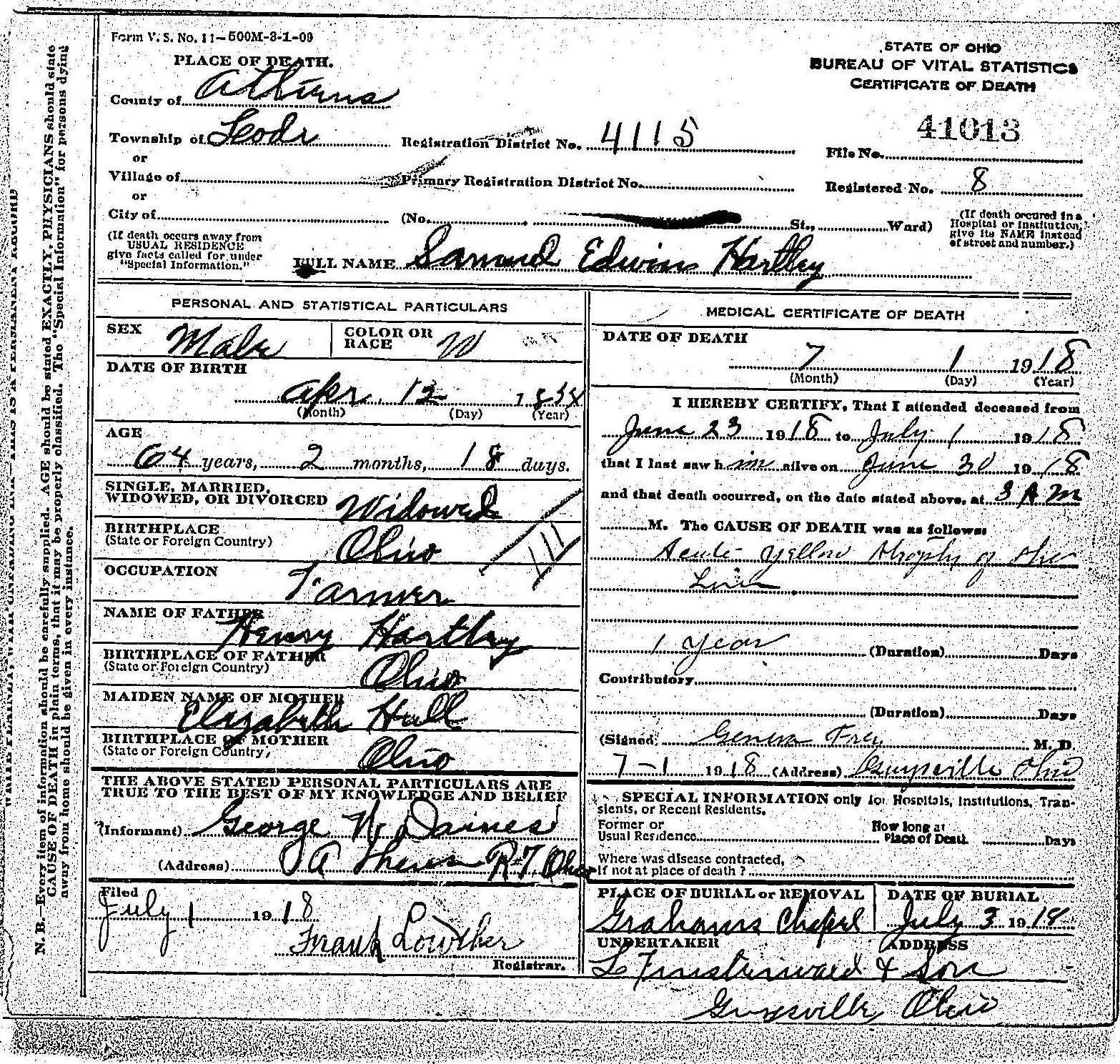
                I do not have a birth record for Samuel (at least, not yet), but we know who his parents are from his death certificate:  Henry Hartley and Elizabeth Hull Hartley.  Clarence and Ada Hartley Goldsberry lived with Samuel for several years, and Clarence and Samuel seem to have had a farming business relationship.  There are several mentions in the local news section of the Athens Messenger of Clarence and Samuel making a business trip to Athens, or taking a load of hay to Athens.  Another mention of Samuel Hartley in the Athens Messenger is not so complimentary.  The February 13, 1902 edition states that Samuel Hartley was indicted upon assault and battery upon Miss Alice Cook, tried before the petit jury, found guilty and fined $25.  I would love to know what happened there! Samuel is buried at Graham Chapel in Lodi Township, Athens County, OH.


                 We can find Henry Hartley, Samuel’s father, in the 1840 and 1850 Census records in Meigs County, Ohio.  By 1860, he is in Athens Township, Athens County and in 1870, he is in Lodi Township, Athens County.  Earlier census records are less certain.  There are tax records for Henry Hartley in Columbiana County, OH for the years of 1833-1838.  In the 1830 and 1820 Census, I believe Henry is living with his father, Edward Hartley in Columbiana County.  Those census do not name each member of the household, but there is a male child of the right age to be Henry, who was born in 1809 in Pennsylvania .  I know that Edward is the father of Henry because he is named in his father’s will.


                Side note: It is important to remember that Ohio’s county boundaries have changed over the years.  In 1803, there were only 17 named counties.  Columbiana County was in northeastern Ohio, adjoining Washington County to the south.  Athens County would have been a part of Washington County at that time.  To add to the confusion in tracing this family, we need to remember county and state boundaries changed in other states as well.  Obviously, West Virginia used to be all Virginia.  Pennsylvania northern boundaries changed.  Connecticut used to claim all of northern Ohio.

 
                Edward Hartley was born in 1781 in Pennsylvania.  Our proof that he was born in PA is found in the 1860 Census, where he is living with his son Abram and states he was born in PA, but then the 1850 Census states that he was born in VA.  However, I found him in the 1810 Census in PA, and found no Edward Hartley in VA in 1810.  He was in PA until at least 1810, where Henry was born.  Edward was in Columbiana County by the 1820 Census. Edward died in 1861 in Columbiana County, OH.

                From here on, I am mostly relying on other researchers.  Several state that Edward’s parents are Roger Hartley III and Dorothy Riley Hartley.   Rodger III was born in PA on March 19, 1733 and is recorded in Society of Friends records, Buckingham Monthly Meeting in Bucks County, PA.  His father was also a Rodger (II), born 1702, who was married to Rebecca Packer on June 21, 1727 in Burlington County, NJ (just across the border from Bucks County, PA). 


               Rodger II purchased 100 acres from William Penn in Solebury, PA.  He also had 50 acres was deeded to him by his father.  Rodger II’s parents were Edward Hartley, born May 16, 1666 in England. He arrived with his brother Henry and Edward’s wife, Sarah Midgley, sometime after their marriage in 1693 in England and before the first record of him purchasing land in 1700. 


               Edward’s mother was Alice Vipoint, whose family was well-known in the English Quaker circles.  His father was Rodger Hartley (the first, at least as far as I know).  His birth was recorded in the Hardshire Society of Friends in Lancashire, England. There is not any documentation of Edward joining the Society of Friends when he arrived in America, but his sons later did.
 
 
                Edward outlived his son Rodger, as proven by Edward’s will, dated June 13, 1744.  His property was left to his son Thomas, son John, daughter Jenet, and to his son Roger Hartley’s seven children. 


Thursday, May 26, 2016

A Sweet, Fragile Flower


              In the previous 24 posts I have written about my ancestors on my Grandpa Clarence Goldsberry’s side.  We have gone back nine and ten generations, with the earliest ancestor arriving at Plymouth Rock in 1621.  Now I am going to turn my attention to my Grandma Ada Goldsberry and her ancestors.
 

                Ada E. Hartley was born January 14, 1890 in Lodi Township, Athens County, Ohio.  She was the youngest of five children, three sisters and one brother.  I had always thought her middle name was Ellen, but her birth certificate says Ada Ethel.  Her obituary says Ada Ellen.  I guess I wasn’t the only one confused!
 
Birth record for Ada Ethel Hartley
 
 
Ada Ellen Goldsberry Obituary

 
                I remember Grandma Goldsberry having coal black hair until the day she died at the age of 79.  She was a tiny little lady.  My dad used to say “she wouldn’t weigh more than 80 pounds soaking wet.”  What is really amazing is that she had babies that supposedly weighed over 10 pounds (though I’m not sure what home scale was used!)  She was frail, both physically and mentally.  I always remember her sitting in a wicker rocker in the corner of the living room, barely speaking when we would go to visit.  I have had the privilege of rocking my own babies and grandbabies in that same wicker rocker.  Ada was admitted to the Athens State Hospital for severe depressions several times during her life, and it was there she died on the day after Christmas, 1969.
Clarence and Ada on their wedding day
 
Clarence and Ada on their 50th anniversary


                Ada married Clarence Goldsberry on July 13, 1907 when she was only 17 years old.  They lived with Ada’s parents until at least 1910.  She had her first child, Grace Katherine, in 1911 when she was 21.  Ralph Emerson was born in 1914; John Dale in 1918; Ruth Irene in 1924; and David in 1935.  By the time David was born, Ada’s health was poor enough that Allen and Glenna Goldsberry (Clarence’s niece) adopted David.  The older children were left to pretty well fend for themselves, with Grace taking on the housekeeping responsibilities at a young age and never marrying or moving out of the family home. 

The last picture I have of Grandma and Grandpa Goldsberry


Clarence and Ada and their five children
 
                Ada’s cause of death was listed as pneumonia.  She was buried at the Burson Cemetery in Shade, Ohio.


                Ada Hartley Goldsberry has a fascinating family history, and I only wish she had been able to tell me about it.  I am eager to share about her amazing ancestors in future posts!

Saturday, May 21, 2016

A Quaker Before William Penn Was A Quaker!


                The wife of John Cutler was Margery Hayhurst (also spelled Hairst and Hearst).  She was born in Easington, Yorkshire, England on March 29, 1671.  She arrived in America on one of William Penn’s ships, with her parents and four siblings in 1682.  The Hayhursts were some of the earliest Quakers in England, including Margery’s parents and grandparents.  They became Quakers in 1652, about fourteen years before William Penn!  Margery's father, Cuthbert Hayhurst III, was in a position of leadership in the church, and suffered persecution for his beliefs.  He was imprisoned several times, including one time for a period of twelve years, 1654-1666.  Cuthbert III and Mary Rudd (or Reed) were married in England in 1666. Imagine their excitement when they heard of the possibility of going to America, where they could worship as they pleased!  Sadly, Cuthbert died in the spring following his arrival to America in 1682, but he died knowing his family would never be persecuted for their beliefs.   As was common with the Quakers, another member wrote a testimony of Cuthbert’s Christian life, which follows:

                “That faithful servant of the Lord, Cuthbert Hayhurst, who departed this life, at his own house in the County of Bucks in Pennsylvania, about the 5th of the 1st month, 1682-83, near the fiftieth year of his age.  He was born at Easington, in Bolland, in the county of York, in Old England, and was one of the worthies in Israel.  My spirit is comforted in a sense of that power, which did attend him in our meetings, for many years in the land of our nativity, and also after he came into these parts; he having been a valiant soldier for the Truth, and borne a faithful testimony to the same, in word, life, and conversation.  He went through many great exercises and imprisonments, and was a comfort unto the faithful and true believers, who follow the Lamb through many tribulations.  He was a worthy instrument in the Lord’s hand against the false teachers and hirelings, going several times to their steeple-houses, and testifying against their deceiving the people.  He also went to several market towns, and, at their crosses, declared and published the Truth as it is in Jesus.  I accompanied him and his dear wife at one of them, where he faithfully warned the people, and exhorted them to repentance; the Divine power and presence eminently attending him, which my soul was made sensible of, to my comfort and satisfaction.

                I can say he was of great service to me and many others, being instrumental in ringing us near unto the Lord, whose name over all we have cause to bless on his behalf; and although his body is gone to the earth, his memorial liveth among the righteous, and I am persuaded his soul is in the enjoyment of peace with the Lord.  I was often with him in the time of his sickness, and beheld his meek, innocent, and lamb-like deportment; being also by his bedside when he departed, which was in a quiet and truly resigned frame, like one falling into a sweet sleep; so that I have great cause to believe he is one of those that died in the Lord, and is at rest with Him for ever.”


Source: U.S. and UK Quaker Published Memorials, 1818-1919.


                Mary died just four years later, when Margery was only 16 years old, in a new country, when both of her parents had died.  She married John Cutler in 1702 and died in 1723.       


For Further Reading:
The History of Bucks County, From the Discovery of the Delaware to the Present Day by William Watts Hart Davis (available on Google Books).      

Wednesday, May 11, 2016

Thomas Bills Married Sisters, Granddaughters of Plymouth Pilgrims


                Mercy Bills Cutler, wife of Benjamin Cutler, was born in 1715 in Monmouth County, New Jersey.  She married Benjamin in Middletown Township, Bucks County, PA on December 16, 1731.  She had transferred her membership from the Shrewsbury Monthly Meeting to Middletown Monthly Meeting two months prior to their marriage. 
 

                Mercy’s parents were Nathaniel and Mary Gardiner Bills.  Nathaniel’s will, proved March 31, 1729, lists his children:  Thomas, Girsham, Daniel, Marcey (Mercy), Catherine, Joanah, and Elisabeth.  Nathaniel must not have been literate, as the will is signed with his mark, not his signature.  On the other hand, the will states he is “very sick and weak,” so maybe he was too ill to sign his name.  Mary had died the year prior.  Mary was the daughter of Richard and Hanna Grover Gardiner and was born in Eastham, MA.
 

                Nathaniel was the son of Thomas and Joanna Twining Bills and was also born in Eastham, MA.  His birth is recorded in the Town Records:


                Thomas Bills was born in 1650 in Eastham, MA.  He married first Anna Twining, on October 3, 1672.  Anna died three years later, and then Thomas married her sister, Joanna, in 1676.  Thomas was a weaver by trade, and moved around quite a bit.  He lived at Yarmouth, MA, Burlington, NJ, and Shrewsbury, NJ. He is thought to be the son of William Bills, one of the first settlers of Cape Cod.
 

                The Twining sisters were the granddaughters of Stephen Deane, a Pilgrim who arrived at Plymouth in the second ship, The Fortune, in November, 1621 and built the first corn mill in the colony.   Isn’t that something that we have an ancestor who arrived at Plymouth around the time of the first Thanksgiving feast?  The Pilgrim must have been so excited to have a ship arrive after barely surviving their first winter, but The Fortune brought very little supplies and more mouths to feed.  It has been fascinating to read more about the Pilgrims and the settlement at Plymouth. 

                The Twining sister’s grandmother, Widow Mary Ring, was also a Plymouth Pilgrim.  The Ring Family was on the ship Speedwell, which was to accompany the Mayflower.  The Speedwell leaked so badly that it had to turn back to England almost immediately.  Mary’s husband, William, became ill and died.  Mary stayed in Holland for nine years, then brought her three children to America in 1629.  We are related to the Ring Family through Ada Goldsberry’s ancestors as well as Clarence Goldsberry’s ancestors.  More about that later!

     Thomas Bills died in Monmouth County, NJ on April 2, 1721.  Joanna died in 1723.
 

Saturday, May 7, 2016

Mercy Me! Disowned and with Presidential Ties!


     Phoebe Lovett Goldsberry’s ancestors, the Lovett family, was described in a previous blog (4/12/16).  Her family, members of the Society of Friends (Quakers) have many records in the Friends Meeting Minutes.  There are many, many pages of Minutes, of which I have read only a few.  Owen Lovett, Phoebe’s great-grandfather is hard to find in the records.  Perhaps this is because he had a relatively short life, dying when he was just forty years old.  On the other hand, he may have left the Quaker church.

     Owen’s wife, however, is another story.  Mercy Stackhouse (1756-1845) is mentioned often in the Meeting Minutes.  Her birth is recorded in the Falls Meeting Minutes on December 4, 1756.  Her parents were Joshua and Margery Cutler Stackhouse.  Her marriage to Owen Lovett is recorded in Northampton County, PA on March 11, 1776.  She was “condemned” by Falls Church for “marrying out of unity,” which means Owen was not a member of a Quaker congregation at the time.  There is also a condemnation for her “outgoing in marriage” in 1789 and in 1827, a Mercy Lovett was “disowned.”  A certificate of disownment is dated on April 4, 1833.  However, a Mercy Lovett, designated a widow, is back on the list of members in 1835.  More research is needed to understand exactly what all went on with our dear Mercy. 
 

     Joshua Stackhouse, Mercy’s father, was the son of Joseph and Sarah Stackhouse, and his birth is recorded in the Middletown Meeting Minutes as being the 21st day of the 5th month in 1732.  One might think that that would be May 21, but until 1751, the Quakers used March 25 as the beginning of the year.  Experts have transcribed his birthdate as July 21, 1732.  His married Margery Cutler on November 22, 1753.  He shows up in the Septennial Census of Pennsylvania in 1786, and died later that year on September 3, 1786.
 

     Joshua’s father, Joseph Stackhouse, was born to Thomas and Grace Stackhouse on July 20, 1703.  His mother died when he was only five years old.  He married Sarah Copeland on May 20, 1725, which was recorded in the Middletown Meeting Minutes.  He died June 7, 1774.
 

      Thomas Stackhouse came to America in 1682, in the fleet of ships arranged by William Penn.  He traveled with his uncle, who was also named Thomas.  Thomas, the nephew, was sometimes listed as Thomas, Jr. even though he was not the son of Thomas, Sr. 
Thomas Stackhouse Property (south of New Town, east of river)
 
Thomas, Jr. was very involved in community affairs, representing his county in the Colonial Assembly of Pennsylvania from 1711-1715.  He also served as a county commissioner, whose duties included laying out roads.  He helped build the first Middletown Meeting House, which they used until they outgrew the space about 1720.  The new Meeting House, built of stone, is still standing in Langhorne, PA, and still in use with the Society of Friends.  Services are at 11 a.m. on Sunday mornings.

     Thomas must not have been able to read and write when he arrived in America because when the members were asked to sign a pledge to not sell rum to the Indians, he had to just make his mark.  However, in 1697, there is a record of him borrowing a “primer” from the Meeting, and must have learned, along with his children, because in 1725, he was able to sign his own name on his son’s marriage certificate. 

     Thomas married three times.  He had nine children with his first wife, Grace Heaton, including our direct-line ancestor, Joseph.  After Grace died, he had five children with his second wife, Ann Mayos.  After Ann’s death, he married Dorothy Heston, but they had no children together.
 

     One of the most interesting facts about the Stackhouse Family is that the George Bush Family is also descended from Thomas Stackhouse!  Imagine that, we share a bloodline with two U.S. Presidents!

Thursday, April 21, 2016

The Godfather of Easton, PA, and Friend of Ben Franklin


     The wife of John Smith was Elizabeth Parsons, born May 4, 1785 in Buckhannon Settlement of Virginia (now West Virginia).  Her marriage record of August 31, 1804 in Harrison County states that her father is Charles Parsons.  Her mother, Elizabeth Chestnut Parsons, had died in 1797, when Elizabeth was only 12 years old.  She and John Smith had at least nine children.

     Charles Parsons, her father, was a Revolutionary War veteran.  He was born in 1745 and joined with Captain John Harness’s Virginia Rangers on October 1, 1775.  He served as a scout.  He had established a “settlement right” of 1400 acres on Elk Creek in Harrison County in 1773 and in 1787, surveyed a road from Randolph County to the Buckhannon Settlement.  He moved his family to Jackson County about 1792, and his wife, Elizabeth Chestnut Parsons died there about 1797.  Charles died in 1823 and was buried in the Baptist Grove Cemetery, which is located right off US Route 33, about five miles east of Ripley, WV.
 

     Charles’ father was William Parsons.  There is much confusion about two William Parsons, who are thought to be father and son, but both worked as surveyors, and both had important accomplishments in their careers.  The son died before the father, which adds to the confusion.  There are many surveys signed by William Parsons, and there are two distinct signatures.  To the best of my knowledge at this point, here is what I know about them. 

     William Parsons, Jr. was born 1722- 1724, probably in Pennsylvania and married Martha Hughes in Pennsylvania on December 5, 1744.  He was probably trained as a surveyor by his father.  He is thought to be the William Parsons that surveyed the “Transpeninsular Line,” which established the east-west boundary between Pennsylvania and Maryland.
 

     William Parsons, Sr. is thought to have been born in England (although some sources say Prussia) on May 6, 1701.  He came to America around 1725.  He was trained as a shoemaker, but was a voracious reader and taught himself mathematics to a remarkable level, which led to his second career as a surveyor.  He caught the attention of Benjamin Franklin, and was asked to join the JUNTO, a “club of mutual improvement,” which was the precursor to the American Philosophical Society.  He served as the first librarian of the JUNTO’s subscription library, the first in the colonies. 

     William Sr. was appointed Surveyor General in 1741, and in 1749 was appointed a Justice of the Peace in 1749 in Lancaster County, PA.  In 1752, he was commissioned to lay out the town of Easton, PA and became known as the “Godfather of Easton,” having laid out its streets and town square, building a jail and school, digging a well and laying out a cemetery.  It is difficult for us to understand what a hard, physical job being a surveyor was.  It involved hiking through wilderness, living in the wilds, and it took its toll on William, forcing him to give up his lucrative career after less than ten years.  In 1755, after hearing of the Indian massacre at nearby Gnaden Hutten, most of the citizens of Easton fled.  William wrote to Governor Morris asking him to provide arms, ammunition, and soldiers to defend the town.  He could not afford to send any of the young men with the message, needing them for defense, so he sent his daughter, Grace.  One account says she went on horseback, making the trip in two days.  Another account says William sent her in a wagon which would return with the needed supplies, and that she would stay in Philadelphia for her safety. 

     As successful as William Sr. was in his career, he was not successful in marriage.  He married a German woman, Johanna Christiana Zeidig in 1722.  She became very active in the Moravian Church, of which William was opposed.  He told her she had to leave the church, or he would leave her.  She would not, and in 1745, he left her, taking their two youngest children with him.  He is supposed to have sent for Johanna when he knew he was dying in 1757, and she left to go to his side, but he died before she arrived.  Benjamin Franklin was in London when he heard of William’s death.  In a letter to Hugh Roberts, Franklin described William as “an odd character,” “a wise man that often acted foolishly,” as someone who “even when prosperous, was always fretting” and “had always the means of happiness without ever enjoying the thing.”

     William died December 22, 1757 at the age of 57.  He is buried in the German Reformed Cemetery in Easton.  The inscription on his marker reads “He rocked Easton in her cradle and watch of her infant footsteps with paternal solicitude.”


Wednesday, April 20, 2016

More Questions Than Answers

     Jeff and I went to Meigs County last week to do some family tree research.  I thought I had prepared very well for the trip:  I had my laptop with ancestry.com and Family Tree Maker, had all my paper files, had looked up where county records were kept and hours for each of those facilities. Our campground had no internet access, and when we were told that, I thought, "No problem.  I have everything on my phone I need."  Well, there wasn't even cell phone service at the campground unless we went up on the hill with the groundskeeper goat.  Again, I thought, "No problem.  There will be wireless at the library and historical society."  The library was undergoing a huge renovation, which looks like it's going to be lovely, but all the records I wanted to look at were in storage.  There was no wireless access.  So we went on to the historical society, which was supposed to hold the earliest public records of Meigs County.  The historical society was supposed to open at 10 a.m. according to their web page, but the sign on the door said they were closed until 1 p.m.  So we went cemetery hunting and returned at 1.  The research room was tiny, with 6 or 8 of the huge record books strewn across the table, so very little room to work, and there was no wireless.  It turns out the only original records the historical society had were estate records.  There were photocopies of other records, which had been made several years ago and shrunk down to 8.5x11 pages from books that were originally about 30x22 inches.  Come to find out, the original records are still at the Court House, and of course, by the time I figured this out it was time for the Court House to close on a Friday afternoon.  So, it was a rather frustrating research trip, but a wonderful camping trip!

     Some of the information I did find led to more questions than answers.  First, I found a book called Meigs County History Book, copyright 1979, by the Meigs County Pioneer and Historical Society.  Many counties made these history books when genealogy research became much more popular with the advent of software programs like Family Tree Maker.  The books contain narratives written by family members  who tell what they know about their family's history.  The narratives contain no source information, and are usually just retelling of family tradition.  The Meigs County History Book contains an article on the Ashworth Family which begins: "The ancestors of the Ashworth family came from Ireland to the United States during the Irish potato famine of 1845-56."  It goes on to state that "James Ashworth was born 1759, died January 8, 1844.  His son Thomas Ashworth, born 1789, died November 25, 1857, married Nancy Ashworth, died July 1, 1876."  The birth and death dates matched what I had, but the rest of the story did not add up.  I felt quite sure I had correct information for the family arriving in 1812, but set out to make sure I had reliable sources.  It is possible that there was another family arriving during the War of 1812 with the same names.  However, I have 1820, 1830, 1840, and 1850 U.S. Census Records showing Thomas Ashcraft living in Meigs County, Ohio.  His marriage to Nancy Blain is recorded on July 1, 1824 in Meigs County.  Although I have not yet found a birth record for his son, John, born in 1828, the 1860 Census tell us that he was born in Ohio.  I feel quite confident that my dates and information on the Ashworth Family shared in an earlier post are correct.

 
John Ashworth, Died Feb 19, 1898, Aged 69 Years, 2 Months, 1 Day
Carleton Cemetery 
 

Thomas Ashworth, Died Nov.  26, 1857, Aged 68 Years
Chester Cemetery
 

Nancy Blain, Wife of Thomas Ashworth
July 1, 1876
Chester Cemetery
 

     Another question was raised when I read through John Ashworth's will.  He left all his property both real and personal to his wife (Caroline) and at her death "to be divided between my heirs--giving to my oldest daughter the sum of five dollars the residue to be equally divided amongst the remaining heirs."  Why was Mary singled out to receive exactly five dollars?  Was it a slight because of her illegitimate son (Clarence Goldsberry)?  Or a smaller amount because she was married to an older, established farmer?  I haven't found the answer to this question yet!

     A third question arose when we were visiting the Smith Cemetery.  Findagrave states that John Smith and his wife, Elizabeth Parsons Smith, are buried in the Smith Cemetery in Bedford Township, Meigs County.  John was a veteran of the War of 1812.  We found Smith Cemetery on the top of a large hill, and it is one of the prettiest cemeteries I have ever visited. 


We made the long trek to the top of the hill, and I was so excited to find this tombstone with a War of 1812 Veteran marker. 
 

     I thought I had found John Smith's grave!  However, on closer examination, I found it actually said John Smitley, not Smith.  Most of the other tombstones were clearly "Smiths," so could this tombstone have been carved incorrectly and used nonetheless?  I came home and did some internet searching for a War of 1812 Veteran John Smitley, and found his last name was correct.  I also discovered that a Smith female had married a Smitley, so there was a family connection.

     Several of the tombstones were completely devoid of their inscriptions.  I assume John and Elizabeth's tombstone engravings have succumbed to weathering.  I looked for a listing of Smith Cemetery transcriptions in the Historical Society, but did not find anything.  As I looked over my notes, I questioned why John and Elizabeth Smith would have been buried in Bedford Township when they had lived in Letart Township? Letart is the southernmost township, and Bedford is one of the most northern townships, and I would estimate it to be 30 miles away.  More research is needed to figure this riddle out!

     I wonder if I can talk Jeff into another few days in Meigs County?  It was a beautiful trip, in spite of the research frustrations!